Zeige Detail-News an
Providing smarter client support – one year of AI in tax consulting and the insights we have gained from it
In the past, the filing of an appeal often required several hours of work. Verification of the legal situation, comparison of judgements and formulation of the text. Today we click on “generate appeal” and an initial, non-reviewed draft appears on the screen within seconds. Of course, this cannot simply be adopted yet. It will still be read, reviewed, revised, supplemented and approved. But the first step has been taken.
From test run to tool
We utilise this approach more often now. AI has become part of our everyday office life. Not spectacular, but effective. Not a solution for everything, but a tool that simplifies matters. What used to take up time now runs in the background. It was clear to us early on: Anyone who wants to help shape the future of the sector must actively engage with AI. As a result, about a year ago we began to systematically integrate AI-based applications into our daily office operations. The launch was deliberately pragmatic: Not as a major future project, but as a practical test during ongoing operations. We were supported in this by various DATEV tools, which simplify routine tasks, accelerate processes and help us with the analysis. But which applications do we use regularly and what benefits do they provide in our day-to-day work life?
What AI does for us
Nowadays there are a multitude of AI applications for the tax consultancy sector – from providers such as Deubner Tax KI, Haufe CoPilot Tax, NWB TaxNavi (TaxIQ) or the better-known market leaders such as ChatGPT, Microsoft Copilot and Gemini. But not every tool is a per-fect fit. We have tested various solutions and primarily rely on two DATEV solutions: the AI innovation lab (“KI-Werkstatt”) with its prototypes and the automation service in accountancy. Below is a presentation of three of our “favourites” as examples:
1. DATEV AI automation service
For a long time, manual bookkeeping was a real “time-waster”, especially for recurring standard cases. Since we started using the DATEV AI automation service, many things run automatically. The AI suggests bookings for us, whether for incoming invoices, outgoing invoices or bank transactions. The system recognizes document contents, learns with each correction and as a result improves week by week. At a glance, we can see which suggestions are safe and can be adopted directly, and where further review is needed. For us, this means the following: Less manual work required for data entry, faster processing in accounting, and more time for training, quality control, and client questions.
2. DATEV appeal generator
This prototype from the DATEV AI innovation lab enables the generation of fully formulated letters of appeal in an instant. For example, relocation costs were disallowed in an income tax return. Instead of having to laboriously draft a letter ourselves, we receive an acceptable draft within minutes that takes current rulings into account and only needs to be supplemented, reviewed and sent. Done!
3. Research aid “Ask LEA”
When is a hidden distribution of profits present? Is there a current notice from the German Federal Ministry of Finance present regarding the tax treatment of photovoltaic systems? What are the benefits of an investment deduction allowance? In the past, it was difficult to collect such information. Today, AI makes it possible to ask questions at the touch of a button with “Ask LEA”, also from the DATEV AI innovation lab. As it were, “Ask LEA” is an intelligent research tool with a focus on taxes. The database provides quick, legally sound answers to tricky tax questions – including sources from more than 150,000 documents such as notices from the German Federal Ministry of Finance, judgements and specialist texts from the DATEV publishing company.
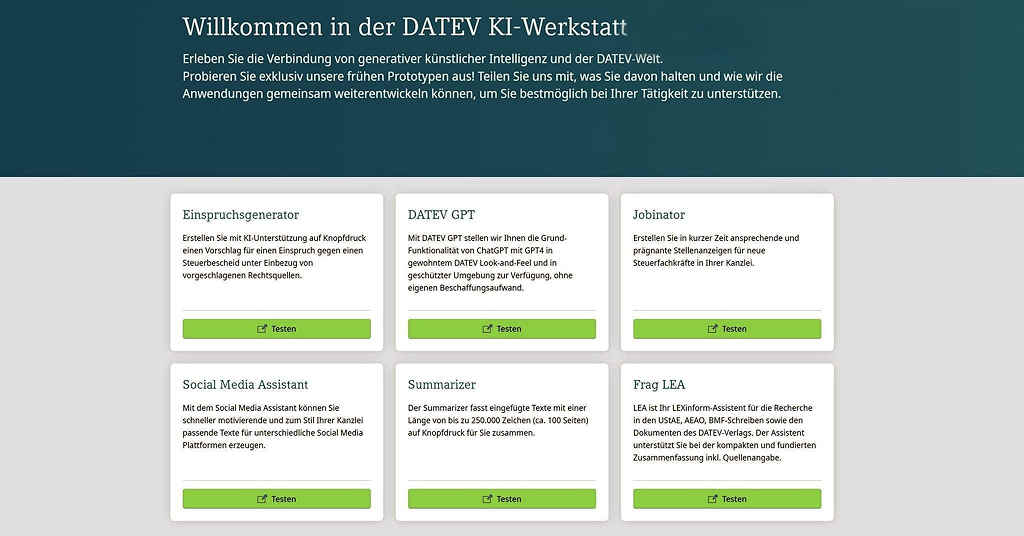 The DATEV AI innovation lab (“KI-Werkstatt”) creates prototypes for automation, research and communication.
No system interruption, but “human in the loop”
The AI applications that we utilise work well together and integrate seamlessly into our DATEV system. This means: We work in a familiar process environment that is GDPR-compliant and legally secure. However, in spite of all the technological advances, one thing remains crucial: The human being. “AI is our assistant, not our replacement,” tax advisor Thomas Langer summarises. Therefore, the principle of “human in the loop” applies to the tax consultancy office. Every automated recommendation is reviewed, commented on and approved. In this way, we combine speed with care, without compromising data protection.
What we learned after a year of AI
After a year of intensive use, we are certain of the following: AI has not only made our office more efficient, but also a calmer environment. Where routines used to take up valuable time, we now use the free time for further training, proactive office work, tax organisation and personal exchange both internally and externally. Moreover, we can focus more strongly on the strategic development of our clients, on topics such as investments, liquidity or development strategies. Nevertheless, every suggestion generated by the AI must be examined critically, as not everything is running flawlessly yet.
Why AI does not automatically mean more affordable
Many people think that AI will automatically make everything more affordable. Unfortunately, that is far from the truth. Because AI also entails expenses: Expensive software licenses, investments in secure IT systems, and time for training and quality control. The savings facilitated by technology in one area, must be expended in another for the careful examination of the results. Whether in regard to a business analysis, company valu-ation or annual financial statement – every report is only released after we have reviewed it. This is how we view modern tax consulting: digital, efficient, and yet personal.
Image sources: istockphoto (dmaerre), DATEV AI innovation lab (“KI-Werkstatt”)